- Company. Think of your idea in terms of its product/service features, the benefits to customers, the personality of your company, what key messages you'll be relaying and the core promises you'll be making to customers.
- Customer. There are three different customers you'll need to think about in relation to your idea: purchasers (those who make the decision or write the check), influencers (the individual, organization or group of people who influence the purchasing decision), and the end users (the person or group of people who will directly interact with your product or service).
- Competitor. Again, there are three different groups you'll need to keep in mind: primary, secondary and tertiary. Their placement within each level is based on how often your business would compete with them and how you would tailor your messages when competing with each of these groups.
- Collaborators. Think of organizations and people who may have an interest in your success but aren't directly paid or rewarded for any success your business might realize, such as associations, the media and other organizations that sell to your customers.

<< Innovating IS Competitive Creativity! >>
Evaluating a New Venture Idea with Four C's
Refine ... Iterate ... Pivot

It starts with an idea, it always does!
The first question, "Who cares? Are there any customers for our idea?" If the answer is "Yes, we think so ...", then move on to the next stage of development: a] create a business model that will fit our target customers and our idea; and b] develop our product and/or service in steps that can be tested and refine (agile engineering, it's called).
If our first customers are happy with the results, find more and more customers and build up our venture. If our first customers aren't all that thrilled, iterate either our business model or our product/service, or both!
[Thank you, Steve Blank.]
Tips for Developing a Venture Strategy
- Develop the vision statement, the mission statement, and the business model
- Describe the industry and context for the firm and its competitors
- Determine the firm’s strengths and weaknesses in the context of the industry and environment
- Describe the firm’s core competencies, its customers, and its competitive advantage
- Describe the opportunities and threats for the venture
- Identify the critical success factors
- Formulate strategic options and select the appropriate strategy
- Translate the strategy into action plans with suitable measures and controls

Mission Statement ... The Critical Success Factor!

The world changes ... client needs, wants, desires; competitive offerings; economic environments; et alia.
Every organization must proactively address change if it is to survive and thrive. The four elements of the Critical Success Factor are excellent focal points for potential innovation in an organization.
The Critical Success Factor statement is also an excellent Mission Statement template.


Crucial Questions (CQs)

Ask and you shall receive!
First Round ... ask the the basic CQs
Second Round ... ask supporting CQs for each of the basics
Third Round ... dig deeper!
Potential Sources of Differentiation
Every successful business is differentiated from its competition ... it could be very unique and significant, or it may be seemingly small and minor. But customers choose one enterprise over another for a reason. Following are some potential sources of value and differentiation to use as a guide when creating a competitive advantage strategy ...
ambiance ... branding ... business model ... community service ... contrived deterrence ... convenience ... copyrights ... cost advantages ... cost advantages independent of scale ... customer relations ... customer responsiveness ... customer service ... delivery ... distinct unique competencies ... economies of scale ... effective sales methods ... efficiency ... experience of doing business ... features ... functionality ... government regulation ... high quality ... image ... innovation ... intellectual property ... limited resources ... location ... low-cost ... manufacturing innovation ... market positioning ... market segmentation ... operational methods ... patents ... performance ... price ... product design ... product differentiation ... product innovation ... product selection ... product-line breadth ... quality ... rarity ... relationships ... reliability ... reputation ... selection ... service ... shopping experience ... supply chain relations ... switching costs ... trademarks ... trade names ... unique capabilities ... value
[1.07]
ambiance ... branding ... business model ... community service ... contrived deterrence ... convenience ... copyrights ... cost advantages ... cost advantages independent of scale ... customer relations ... customer responsiveness ... customer service ... delivery ... distinct unique competencies ... economies of scale ... effective sales methods ... efficiency ... experience of doing business ... features ... functionality ... government regulation ... high quality ... image ... innovation ... intellectual property ... limited resources ... location ... low-cost ... manufacturing innovation ... market positioning ... market segmentation ... operational methods ... patents ... performance ... price ... product design ... product differentiation ... product innovation ... product selection ... product-line breadth ... quality ... rarity ... relationships ... reliability ... reputation ... selection ... service ... shopping experience ... supply chain relations ... switching costs ... trademarks ... trade names ... unique capabilities ... value
[1.07]
Critical Path ...
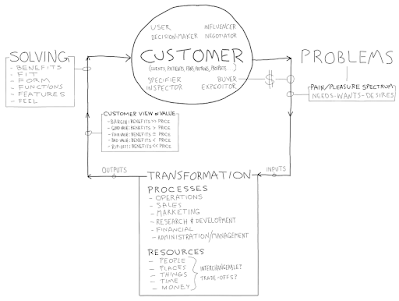
Ultimately, the function of a business venture is to satisfy customer needs, wants, and desires by transforming their problems into solutions (products, services, processes, value ...) and capturing a bit of profit along the way.

Subscribe to:
Comments (Atom)